
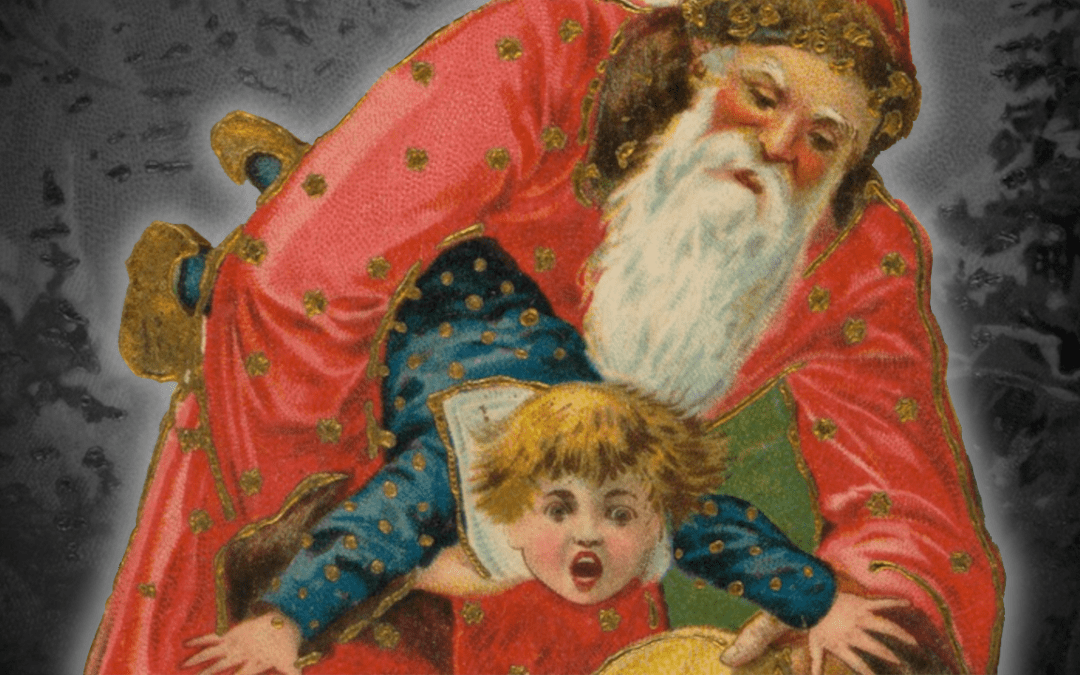
Christmas – it’s the best time of the year. Unless your name is Scrooge, in which case you’ll be harassed all night for no reason. This all despite you just wanting to mind your own business… Which should be your right as a free human being. But anyway, it’s a jolly time of year. So some of the dark origins of Christmas may surprise you. From violent rioters to evil spirits, here are some notable dark origins of Christmas traditions.
Christmas Carollers
Christmas Carollers are one of the more annoying occurrences of this time of year. But back in the 1700s, they were a lot more than just annoying. Often, they would break into people’s homes and demand to be fed. Fail to give them your best quality wine and they grew violent. Sometimes to the point of murder. It was basically just an angry mob going from house to house bullying people into rewarding them. As the night went on they would get more and more drunk – which I imagine only made them less violent. If all they did was mildly vandalise your home, you’d be considered one of the lucky ones. Arson was a common occurrence.
The home invasions affected both upper and lower class families. No one was safe, and countless people were genuinely traumatised by carolling. It got so bad there was a national campaign in England to ban the practise. How did this even become a tradition? I have no idea. But speaking of cajolers, many of the songs they sing were inspired by much older, and darker, happenings.
Christmas Carols
The Coventry Carol is one of the more enduring Christmas carols of all, dating to the 16th century. But instead of being about reindeer and gift giving, it’s the story of King Herod ordering the killing of all baby boys in Bethlehem. Given Christmas was seen as an exclusively religious holiday, it’s not too shocking in principle. But a Christmas Carol featuring lines like “All young children to slay” is a bit crazy.
Then there’s the story of John de Brebeuf, a 17th century French missionary. His goal in life was to help spread Christianity in Canada – specifically to the indigenous Huron people. To do so, he wrote his own original Christmas carol. Known as the Huron Carol, it blended the tale of Jesus’ birth with elements of Huron culture. So far there’s nothing dark about it. The problem is though, the Huron Carol proved popular. So popular that many Hurons adopted Christianity. But some other native groups viewed the carol as a threat.
In 1649 de Brebeuf was captured by the Iroquois. He was then slowly tortured to death. The missionary was burnt, flayed, and had boiling water poured over him. That’s what happens when you invent a new Christmas carol.
Santa’s Chimney Trick
It is a little odd that father Christmas breaks into houses – especially through chimneys. Folklore has always viewed chimneys with suspicion, as if they were secret passageways to a darker world. Witches, goblins, and dwarves were all said to enter houses through chimneys. In fact, this caused many to block them off each night before going to bed. Perhaps the origins of Christmas traditions are not entirely different from these older legends, despite him being benevolent. Some even believe Christmas baubles come from an early practise of creating charms to ward off witches.
On the other hand, some claim it comes from the real life story of Saint Nicholas. That he would drop gifts down the chimneys of impoverished home owners. The problem with this theory is that chimneys were not widely in use during the lifetime of Saint Nicholas. As a matter of fact, they would not be for another eight centuries. It’s hard to say for certain. The dark origins of Christmas traditions can be hard to pin down. More often than not, they are a blend of historical fact and mythology.
Modern Day Darkness
Much of our modern understanding of Christmas came together during the Victorian era, a time of deep fear and superstition. This would explain why ghost stories came to be such a strong part of the holiday season. Or why Christmas cards were so creepy when they first came to market. So perhaps the dark origins of Christmas traditions are not all that distant to modern practices.